


Cavour And The Unification Of Italy
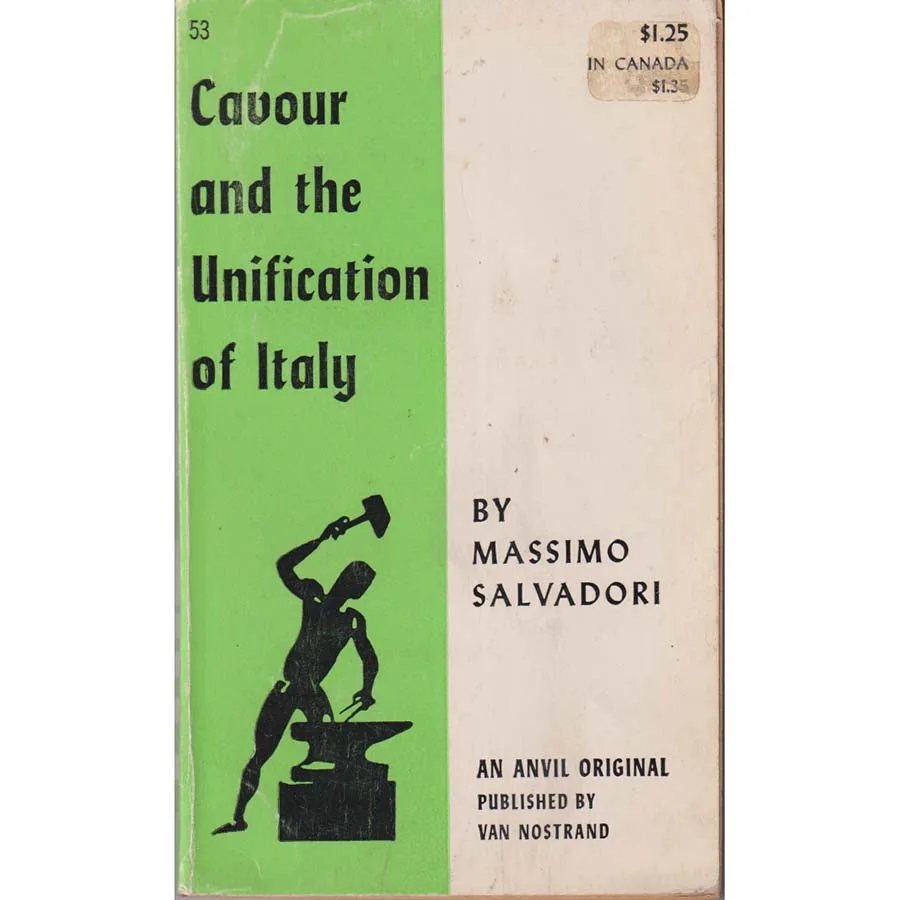
Publisher: Van Nostrand
Format: Paperback
ISBN: none
Cavour and the Unification of Italy (1961) — Massimo Salvadori (Van Nostrand)
ISBN: None (because 1961 didn’t need barcodes to feel important)
Condition: Good
Sold by: Crappy Old Books
If you’ve ever looked at a modern nation-state and thought, “Yes, but who did the admin?” then allow this quietly formidable 1961 volume to introduce you to Count Camillo di Cavour: part statesman, part spreadsheet, part chess player, and — depending on your sympathy for 19th-century realpolitik — either the cool-headed midwife of Italian unity or the man who turned history into a committee meeting and still won.
Massimo Salvadori’s Cavour and the Unification of Italy is a brisk, serious, mid-century guide to one of Europe’s great political construction projects: taking a patchwork of kingdoms, duchies, foreign interests, romantic uprisings and extremely enthusiastic moustaches, then somehow turning it into Italy (with only the usual amount of diplomatic manoeuvring, backroom deal-making, and strategically timed conflict). It’s the story of how nationalism got its big break — not solely through fiery speeches and heroic barricades, but via careful alliances, international leverage, and the sort of patient plotting that makes you realise revolutions also need project managers.
Salvadori writes with that pleasingly no-nonsense tone you only get from proper historical scholarship of the era: confident, structured, slightly severe, and utterly uninterested in your modern preference for “hot takes.” This is not a glossy coffee-table romp through the Risorgimento. This is the nuts and bolts: the diplomacy, the strategy, the pressures from France and Austria, the balancing act between principle and pragmatism, and the political tightrope walk of making Italy “unified” while keeping it workable. Expect Cavour to appear less as a romantic icon and more as a man who could probably unify your filing cabinet if you gave him a week and a good pen.
And yet, there’s something oddly thrilling about it. Because the unification of Italy — for all the flags and anthems — is also a tale of negotiations, constraints, and hard choices. It’s a reminder that history often turns on the people who can sit through meetings, read the room, and outlast everyone else without looking like they’ve broken a sweat.
Condition: Good, meaning it’s been sensibly handled by previous readers who likely approached it with a pencil, a serious face, and possibly a faint sense of dread about exams. Expect honest shelfwear commensurate with a book that has done its duty. Still perfectly readable, still sturdy, still ready to make you feel either impressively informed or quietly inadequate about your own organisational skills.
Perfect for historians, politics obsessives, Risorgimento enthusiasts, students, collectors of solid mid-century academic publishing, or anyone who enjoys the realisation that the making of a nation can hinge on one determined man’s ability to play diplomacy like a long, meticulous game of cards.
From Crappy Old Books: because not every epic is swordplay and speeches. Sometimes it’s strategy, compromise, and Cavour — calmly rearranging the map while everyone else argues about the poetry.
Keep browsing: See more History books Other books by Massimo Salvadori
